Why Your Church Might Be Invisible to the Next Generation
August 27, 2026 · 7 min read · Jeff Karnes

August 27, 2026 · 7 min read · Jeff Karnes
I’m a pastor who also develops websites for small businesses and churches. Coming out of COVID, we had a really tough time, like most churches. We stopped meeting in person, and when we reopened, a lot of our congregants didn’t come back. During that time, I started digging into the digital experience of the church, especially our website. How does Google actually decide what shows up in search results? I realized that if our church wasn’t showing up, that was a real problem, because people simply couldn’t find us online.
Since then, our church has worked its way to the number one search result in our area, and our website has become a genuine front door for our ministry. Now I want to help other churches reach the people in their own areas, and reach them well. To understand why this matters, it helps to look at the broader trends happening across the nation.
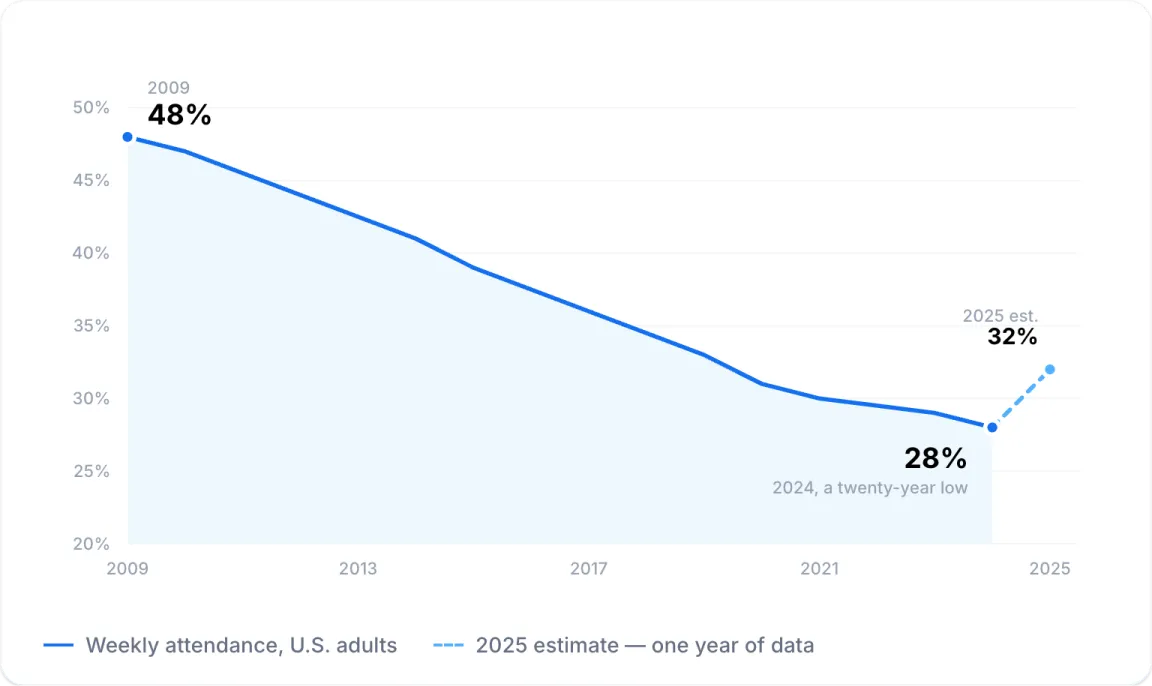
In 2009, roughly 48% of American adults attended church weekly. By 2024, that number had fallen to 28%, according to Barna Group’s long-running State of the Church tracking, based on interviews with over 126,000 adults across more than two decades. That’s not a blip. That’s a twenty-year slide.
Over that same stretch, the share of unchurched adults in America climbed from around 30% to 43%, based on Barna and George Barna’s Churchless research. Most of those people didn’t grow up outside the church. They grew up inside it and left.
Barna’s most recent 2025 data actually show a modest rebound — up to an estimated 32%, led by Gen Z and Millennials. That’s genuinely encouraging. But one year of upward movement doesn’t undo two decades of decline, and building a plan around the long-term trend is still the wiser bet than assuming the dip already fixed itself.
Whatever the exact percentage in your county, you already know the shape of this. You’ve watched the same faces stop showing up. You’ve wondered where the people in their twenties and thirties went.
Here’s something that has also stood out in recent years. It’s not that pastors are unaware of the decline. It’s what the decline is doing to them personally.
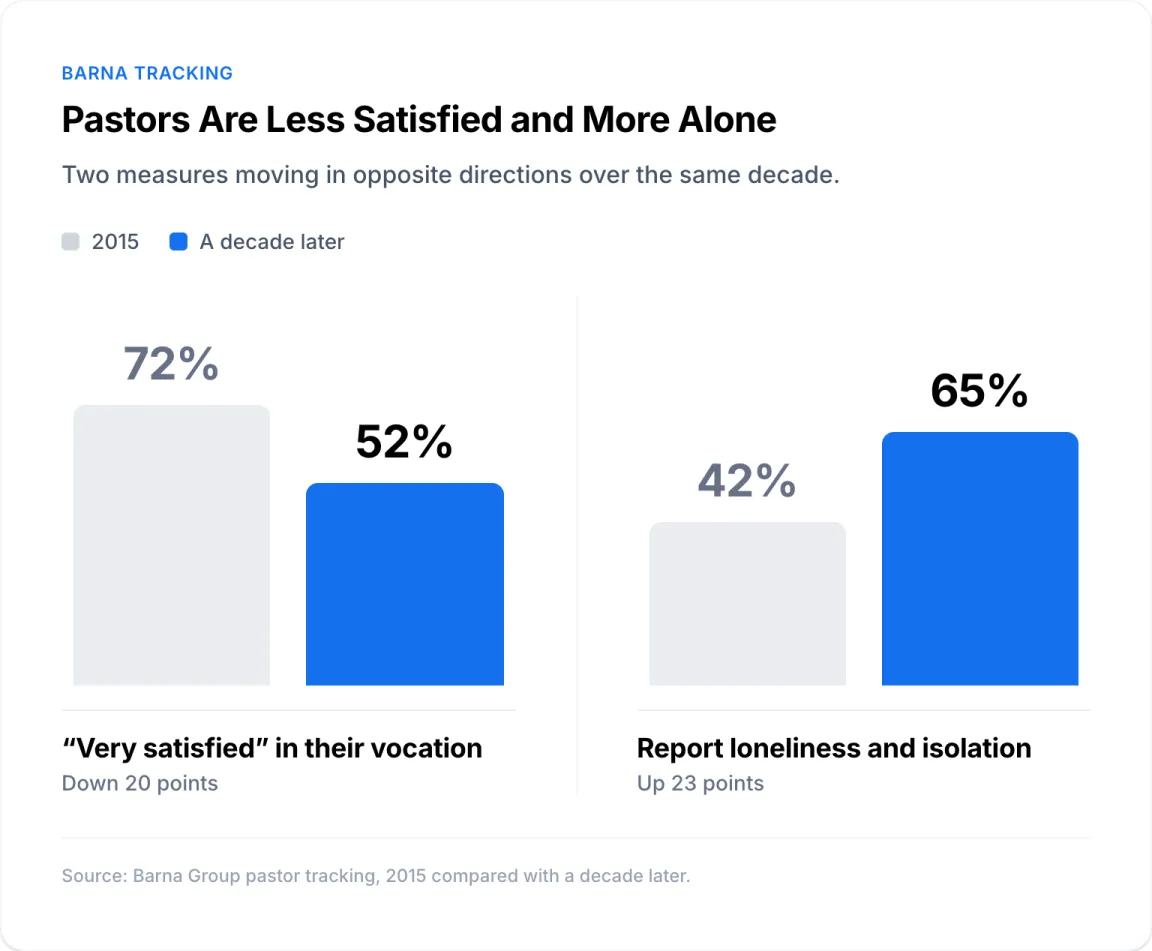
Barna’s tracking shows the share of pastors who describe themselves as “very satisfied” in their vocation fell from 72% in 2015 to 52% a decade later. Reports of loneliness and isolation among pastors rose to 65%, up from 42% over that same window. And when Barna asked pastors to name their single biggest concern for their local church, the top answer — at 51% — was reaching a younger generation.
That tracks with what’s happening inside the generation itself. Barna has found that 59% of Millennials raised in the church have dropped out of regular attendance at some point in their adult life. And in a finding I didn’t expect, nearly half of practicing Christian Millennials — 47% — said they believe it’s wrong to try to convert someone of a different faith to Christianity. The discomfort isn’t just about showing up anymore. It’s about whether outreach itself still feels appropriate to the people you’re trying to reach.
None of this is a website problem at its root. It’s a much deeper cultural and spiritual shift, and no landing page fixes it. But there’s one narrower piece of it that actually is fixable, and it’s the piece most churches have never looked at.
Before I get into what a good website actually requires, here’s something with zero cost that makes a real difference: claim and fully fill out your church’s Google Business Profile.
Service times. Address. Photos. A link to your site. It sounds almost too simple to matter, but Google Business Profile is frequently the very first thing a person sees before they ever click through to a website — and an incomplete or unclaimed listing quietly tells a stranger this church isn’t really paying attention. It takes about twenty minutes, and you don’t need me, or anyone, to do it for you.
Here’s where we can get specific, and where I think most pastors would be surprised.
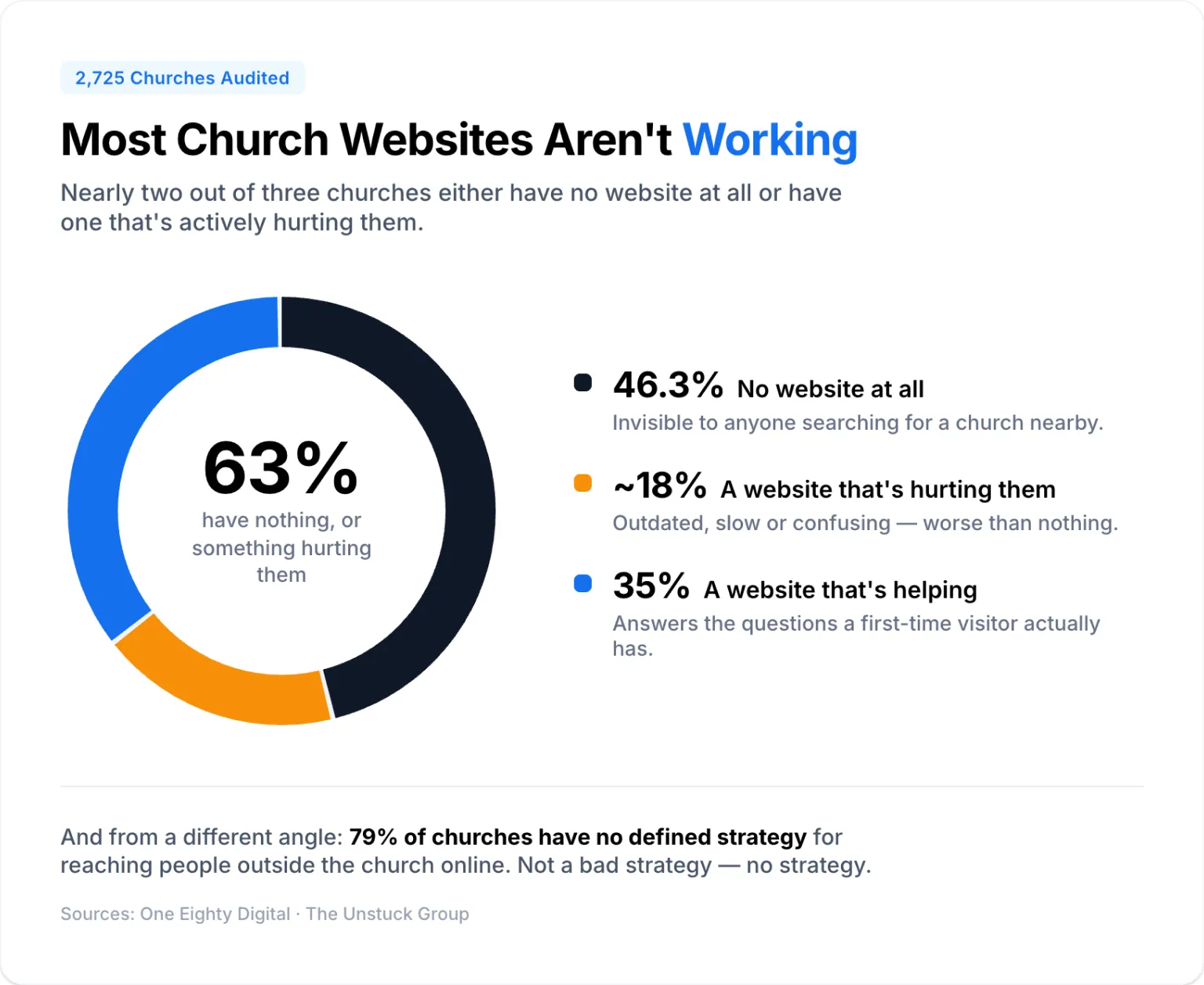
One Eighty Digital audited 2,725 churches across an entire state and found that 46.3% had no website at all. Only 35% had a website that was actually helping their congregation — meaning the majority, 63%, either had nothing or had something actively working against them.
The Unstuck Group found something similar from a different angle: 79% of churches have no defined strategy for reaching people outside the church online. Not a bad strategy. No strategy.
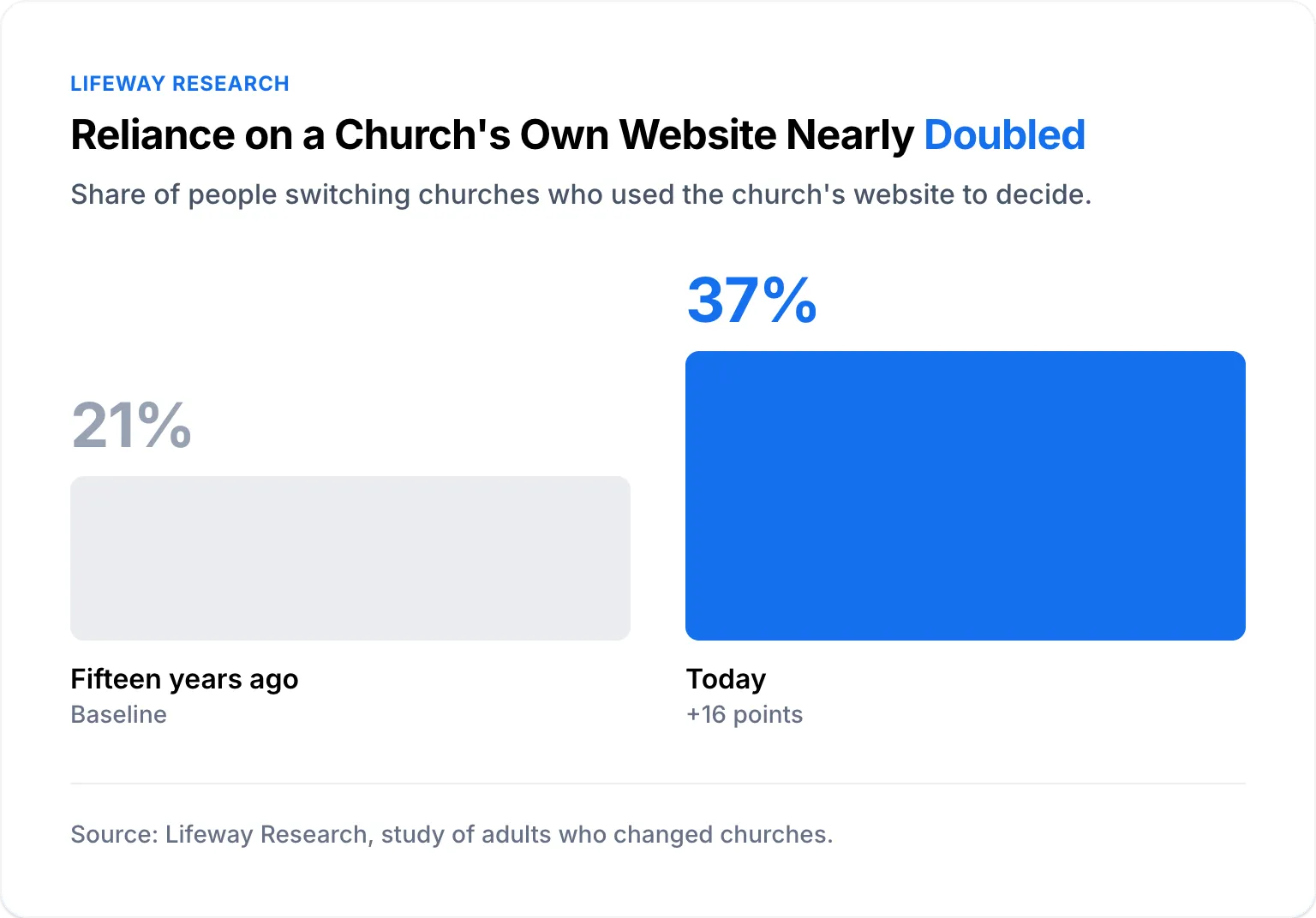
Meanwhile, the way people actually find churches has shifted underneath all of this. Lifeway Research found that reliance on a church’s own website — among people switching churches — nearly doubled in fifteen years, from 21% up to 37%. And if you’re hoping your denomination’s directory will do the work for you, Grey Matter Research checked nearly 8,000 individual church listings across 123 denominations and found only a 32% chance the listed link even worked.
Then there’s the matter of what happens once someone does land on your site. Research out of Carleton University found that visitors form a lasting impression of a website in as little as 50 milliseconds — faster than it takes to read this sentence. Stanford’s Persuasive Technology Lab found that when people explain why they trust or distrust a website, visual design is the single most cited reason, referenced in 46.1% of credibility judgments. And with mobile devices now generating over 63% of all web traffic, a site that doesn’t work cleanly on a phone is failing most of the people who ever visit it.
Put plainly: the majority of churches either have no digital front door, or one that quietly undermines the very trust they’re trying to build.
If you’re considering doing something about this, here are four honest questions worth asking anyone you’re thinking of hiring.
Do they actually understand church culture, or are they applying a generic small business template? A church website has different needs than a dentist’s office. Visitors want service times and a sense of what a first visit feels like, not a sales funnel.
Can they show you real, specific proof — not just a portfolio of logos? Ask what actually changed for a real church they’ve worked with.
What happens after launch? Service times change. Staff changes. A church website that can’t be easily updated becomes outdated within a year, which defeats the purpose entirely.
And does the pricing actually fit a church budget? Most churches don’t have room for a five-figure agency retainer, and shouldn’t need one for a five-page site.
I mentioned earlier that our own church wasn’t showing up at the top when people searched “churches near me.” Here’s the rest of that story. After rebuilding our site and prioritizing the right keywords, Definition Church went to the number one result for “churches near me” in our area of the Piedmont Triad.
I’m not sharing that to sell you something in this article. I’m sharing it because it’s the actual, checkable result of doing the boring, unglamorous work: a real website, a claimed Google listing, and someone paying attention to both over time. SEO is a long game. You have to commit to working at it over time. It isn’t a quick fix.
My passion is helping churches build a great front door and a great digital experience. Too often, the church lags behind the rest of the world here. But it doesn’t have to be that way. We can still reach the next generation.
Jeff Karnes is a pastor and web designer in the Piedmont Triad, and the founder of Karnes Design. Reach him at jeff@karnes.design.
Sources: Barna Group, State of the Church 2025; Barna Group, Churchless research; Barna Group, pastoral wellbeing and vocational satisfaction tracking; Lifeway Research, church switching behavior studies; Grey Matter Research, “Click Here to Find a Church (Maybe),” 2015; One Eighty Digital, “The State of Church Websites,” Feb. 2025; The Unstuck Group, Q3 2020 Unstuck Church Report; Gitte Lindgaard et al., Carleton University, Behaviour & Information Technology, 2006; Stanford Persuasive Technology Lab / Consumer Reports WebWatch, 2002.